This article was also featured in Fanfare Summer 2026.
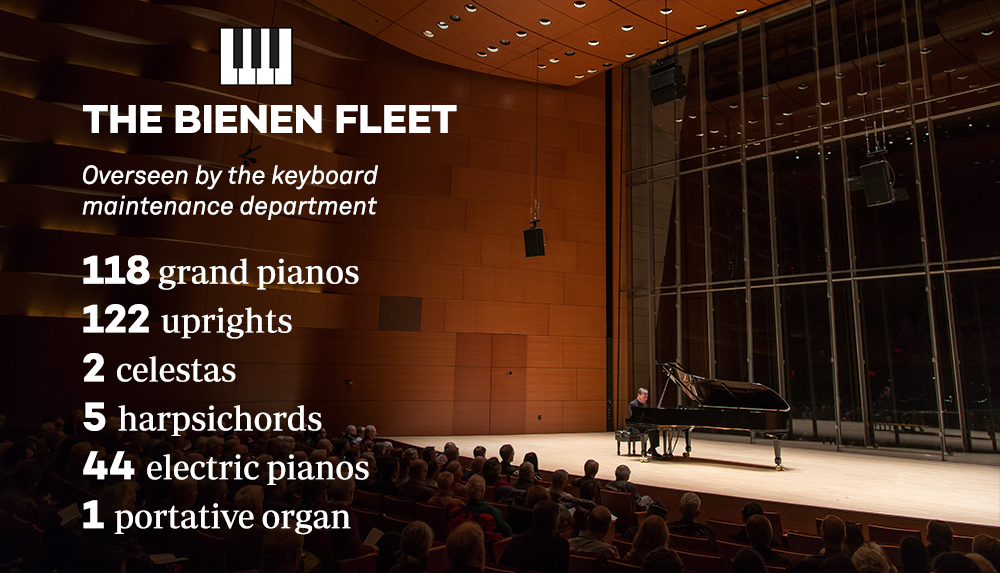
Among the busiest people at the Bienen School of Music are the keyboard maintenance staff, who use their specialized skills to oversee an impressive fleet of pianos.
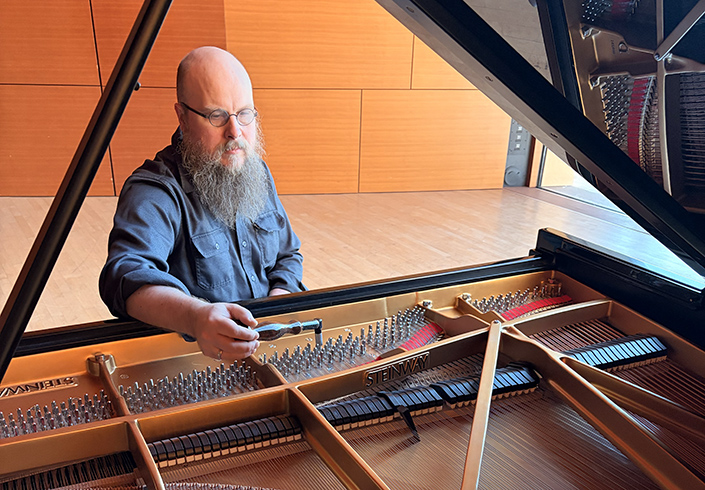
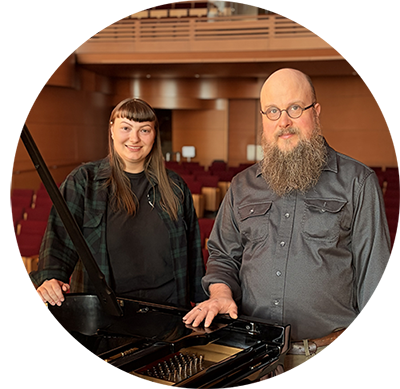 Hours before some of the world’s most celebrated pianists take the Galvin Recital Hall stage for Skyline Piano Artist Series performances, Wesley Owen can be found tinkering with one of the Bienen School’s model D Steinway pianos—tuning, voicing, and making adjustments to meet the artists’ unique specifications. As supervisor of keyboard maintenance, Owen (photo, far right) is responsible for providing the highest level of tuning, maintenance, and concert preparation for nearly 300 instruments across the school.
Bienen’s annual performance calendar of more than 400 concerts and events keeps Owen and piano technician Chris Scroggins (left) quite busy. Both are highly skilled at their craft, with years of experience, certifications, and memberships in the Piano Technicians Guild, a global network of more than 3,300 members. Three private contractors support their work, including one intern, a role that Owen himself previously held under the guidance of former Northwestern supervisors Ken Eschete and Bill Schwartz. Today Owen and Scroggins continue a legacy of excellence and ensure that each instrument is ready to meet the school’s academic and performance needs. They spoke with Fanfare to share more about their essential work.
What skills make for an excellent piano technician?
OWEN: The work demands a broad and adaptable skill set. You must be proficient in all aspects of piano maintenance, including tuning, regulation, voicing, and parts replacement, and be prepared to care for a diverse fleet of instruments of varying ages and usage levels. The role also requires strong planning abilities to anticipate needs in advance, as well as the flexibility to troubleshoot and resolve unexpected issues as they arise.
What amount of training goes into this craft?
SCROGGINS: Piano technology is traditionally learned through years of apprenticeship. We were both very fortunate to graduate from North Bennet Street School, which provides a foundation of tuning, repairs, and action regulation. Following that program, I took the Piano Technicians Guild exams to become a registered technician and continued my education by apprenticing in a world-class rebuilding shop and working summers at the Aspen Music Festival. I’ve also completed all the training that the Steinway & Sons piano factory offers.
Describe a typical day at Bienen.
OWEN: Each day looks a little different. Most mornings are spent tuning between two and six pianos, followed by maintenance work in the afternoon. Some days are devoted entirely to shop work, while others are spent tuning from morning to evening and being on standby for a guest artist. There are also days when we move pianos or the portative organ between buildings or handle repairs such as fixing piano benches.
What’s one of the most interesting days at work recently?
OWEN: Working with Stephen Hough for the Skyline Piano Artist Series concert was a thrill. He is a truly amazing artist and was a great deal of fun to speak with about pianos.
SCROGGINS: There is always something interesting. I like days that have a lot of variety, like when I work in a venue space, then go tune the practice room harpsichord, then spend most of the afternoon in the shop working on a piano that is getting new parts.
What would people be surprised to learn about your work?
SCROGGINS: Maybe just how meticulous it is beyond tuning. Each note on the piano has over 20 moving parts that all need very fine microadjustments, which all create nuances in the touch. Each note’s hammer felt can respond differently to the physical manipulation we do, and it is up to us to make judgments with our ears to get every hammer sounding even in tone.
What’s the best part of your job?
SCROGGINS: I remind myself every day how lucky I am to do something I love so much, and I get to put a lot of effort into improving my own skills and knowledge while trying to improve the pianos. I am also happy to be working at Bienen with all the incredible staff who have been so welcoming and supportive.
OWEN: My favorite part is solving a problem that I have not ever encountered before. Even after years of doing this work, new challenges pop up when I do not expect them. A close second favorite is working with the high-level artists. It is often a thrill to see up close what they can do with the pianos.