This article was also featured in Fanfare Summer 2026.
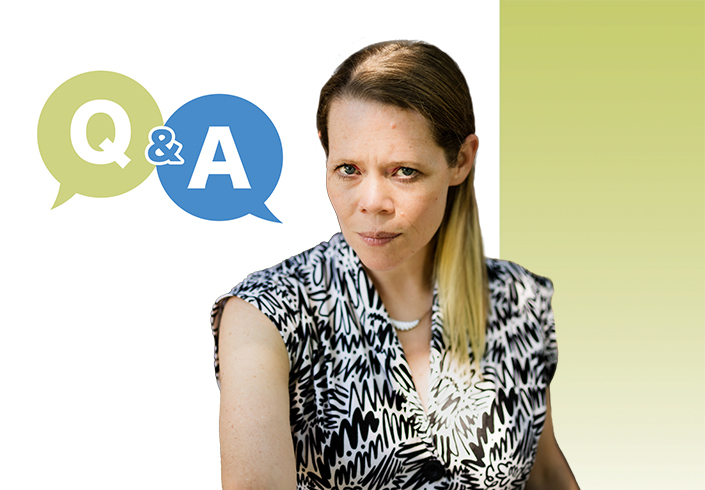
A New York–based saxophonist, composer, educator, and social justice advocate, Caroline Davis ’10 PhD holds a doctorate in music cognition from Bienen. She has released nine albums as a leader and is the recipient of numerous awards, including a 2025 Guggenheim Fellowship.
What was your favorite musical moment at Northwestern?
Northwestern was the host of the International Society for Improvised Music Conference in 2007, and I performed there with a group of faculty and composers in an ensemble we called backGammon. My favorite thing about that conference was that Pauline Oliveros gave one of the most impactful workshops I remember seeing, about engaging with virtual reality and music. I asked how she dealt with the time delay of working with people on VR, when the sound is delayed a little bit and she’s playing music. She said, “Well, consciousness is a delay. I see everything as related to the delay of thought and consciousness to reality.” It totally blew my mind.
Tell us about your journey since graduating.
Before I finished at Northwestern, I started working at DePaul teaching a course for education graduate students who wanted to incorporate more cognitive research in their practical work in schools. Then I taught adjunct at Columbia College. I started playing more and writing more music, and I felt really compelled to continue that journey. I felt that moving to New York was the best place for me because it was a place of high activity in the music that I wanted to play.
What has been a career highlight?
Last year I was able to perform with and for [activist] Angela Davis at the Chicago Humanities Festival. Nicole Mitchell, a friend who is a phenomenal flutist and composer, wrote a suite of music inspired by Angela. Former Chicago poet laureate avery r. young and a group of musicians from different places performed with us as well. It was one of the most incredible moments of my life, hanging out with Angela, hearing her speak before the concert, and playing music around her voice.
What inspires you?
Right now I would say it's people and communities that are dialoguing about the prison industrial complex. It sounds heavy and dark, but I have a lot of hope in communities who support people behind bars. I've been organizing community group discussions called "Creative Beyond Incarceration" in my neighborhood at the Brooklyn Artery, a place that my friend owns, where we gather as people who are affected by incarceration.
Tell us about your Guggenheim project.
I’m interested in engaging with the structures incarcerated people inhabit—prisons mostly—looking at where they are in the United States, the people who work there, and the people who are inside them. I hope to engage both with community members and field recordings at the sites of prisons, and with the people who go inside on a daily basis. But gaining trust is a slow process. Next year I plan to write music incorporating some of the field and video recordings of these places.
I work for two organizations who go on the inside with instruments. One of them is called Musicambia, which means music change. They offer music classes for incarcerated people. I've been going into Sing Sing Correctional Facility in New York; that program had a partnership with Carnegie Hall at its inception. I also work as a board member for Freer Records, which is a label that records people inside and/or people who just got out of prison who want to release music. Finally, I have done workshops at youth facilities in Oregon with my friend and activist Adam Carpinelli and his organization Keys Beats Bars.
The incarcerated are often an overlooked population. What are your hopes for this project?
My ultimate dream is visibility. This is more conceptual, but I want to humanize people who are on the inside. I want to make music and make this whole project—the visual component, the audio component of their voices, and my compositions—part of a bigger concert experience. I’m interested in creating visibility through sound.