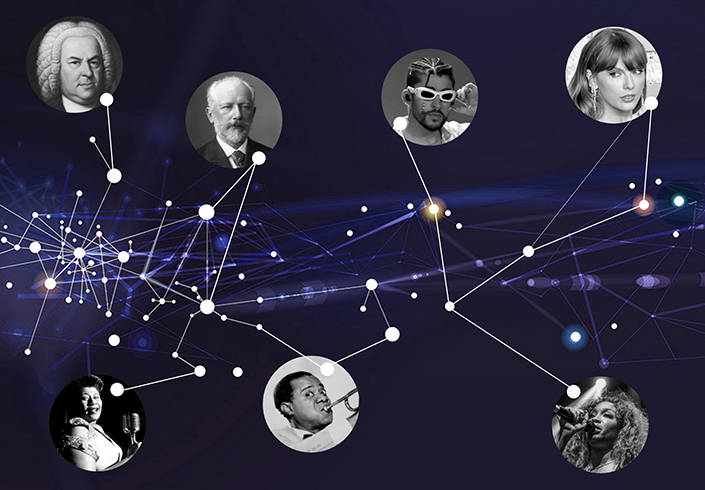
A new certificate program at Northwestern University aims to equip students to be critical users and thoughtful designers of AI technologies in music.
Developed through the Northwestern Network for Collaborative Intelligence (NNCI), and offered jointly by the Bienen School of Music and the McCormick School of Engineering and Applied Science, this interdisciplinary certificate is open to all Northwestern undergraduate students. Through coursework in both computer science and music theory and cognition, students will explore key applications of AI and machine learning in music, including music information retrieval, recommendation systems, performance systems, and generative composition.
The certificate program is managed by Daniel Shanahan, associate professor and coordinator of music theory and cognition, and Michael Horn, professor of computer science and the learning sciences.
“Our goal is not simply for students to build tools, but to interrogate those tools and approach them through a critical and ethics-centered approach," said Shanahan. “This means understanding both the computational systems and the human listening experiences that those systems are trying to model. This combination is something that Northwestern is uniquely positioned to be able to offer.”
Through this program, students will understand how music and audio are represented computationally and how datasets are created, including the ethical and legal considerations this entails. They will be able to critically evaluate the role of AI technologies in music and evaluate, critique, and design tools that support musical expression, composition, or analysis. Students will also better understand how humans interpret music and how this relates to the design of music AI systems.
Some examples of the questions this certificate will explore:
- What ethical frameworks should we consider for algorithmic music creation, distribution, and curation?
- How do we design new tools to support creative expression and music learning?
- How are musical structures in audio encoded by computers, and how can we create tools to find salient structures in music audio?
- How are AI-driven streaming systems using human listening experiences to model their technology?
Students interested in declaring the certificate program should contact their academic advisor.
Note: The Bienen School does not promote the use of artificial intelligence as a replacement for human performance, composition, or creativity. The objective of this program is not to diminish human expression—rather, it is to examine the intersections between music and algorithmic ecosystems. The program is intended to provide those working in this space with the ethical, artistic, and humanistic framework needed to better understand the impacts of these systems.