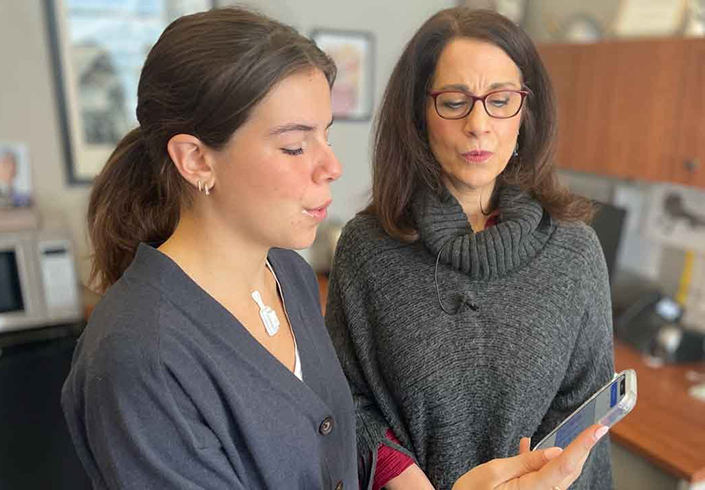
Research related to vocal health led by Bienen senior lecturer Theresa Brancaccio is being supported through the new Querrey Simpson Institute for Translational Engineering for Advanced Medical Systems (QSI-TEAMS) at Northwestern.
QSI-TEAMS aims to expedite the clinical validation, adoption and launch of pioneering technologies at the intersections of engineering, science and medicine. Leading the initiative is John A. Rogers, the Louis Simpson and Kimberly Querrey Professor of Materials Science and Engineering, Biomedical Engineering and Neurological Surgery.
Brancaccio and speech pathologist Dr. Aaron Johnson ’95, ’99 MMus worked with Rogers’s team to develop the first wearable device to continuously track how much people use their voices, alerting them to overuse before vocal fatigue and potential injury set in.
The device comfortably adheres to the upper chest to sense subtle vibrations associated with talking and singing, with separate simultaneous measurements of ambient sounds. From there, the captured data is streamed, in real-time via Bluetooth, to a users’ smartphone or tablet, so they can monitor vocal activities throughout the day and measure cumulative vocal usage and quality. The technology could help preserve the voice for people who sing or talk for a living. It could help clinicians remotely monitor patients with voice disorders throughout their treatment.
“Being selected as one of the launch projects for QSI-TEAMS marks a pivotal moment in our ability to fully realize the project’s potential,” said Brancaccio. “Our smart wearable aims to help individuals prevent vocal fatigue and injury while also opening new possibilities for clinical voice care and research in areas such as hearing-loss populations, Parkinson’s disease and cancer radiation.”
Learn more about the six research initiatives selected as QSI-TEAMS launch projects.